
When most of the teeth are gone, or extraction is the only realistic option left, the traditional answer has been a removable denture. For patients who want something fixed, stable, and indistinguishable from natural teeth under normal use, the modern alternative is a full-arch implant-supported bridge. Two systems dominate this space: All-on-4, which anchors a complete arch on four titanium implants, and All-on-6, which uses six. The difference sounds minimal on paper. In practice, it shapes how the restoration distributes bite force, how much bone the implants need to engage, how the bridge performs over a decade, and what the patient pays. Across Europe, clinics have been seeing consistent demand from UK, Irish, and Scandinavian patients who want this done at prices that do not require selling an asset to fund dental work. Many have ended up at Orto Nova in Croatia, a dental clinic with an established track record in full-arch implant cases and a team that has handled complex restorations for international patients over several years.
The choice between All-on-4 vs All-on-6 is one most patients encounter once, under considerable stress, with little preparation time.
The decision carries real consequences: an implant placed into insufficient bone, or a bridge loaded with more chewing force than four implants can reliably distribute, can require corrective work years later that costs more than the original treatment. This article covers what each system involves structurally, what bone density and volume requirements each carries, which clinical profiles favor four implants over six, and where the cost and longevity trade-offs sit in practice. It also addresses the dental tourism angle, since a large proportion of patients making this decision are doing so with travel and a compressed timeline as part of the equation. The aim is to give prospective patients enough grounding to arrive at a specialist consultation with focused questions and make a choice based on clinical logic rather than price alone.
What the “All-on” System Actually Means

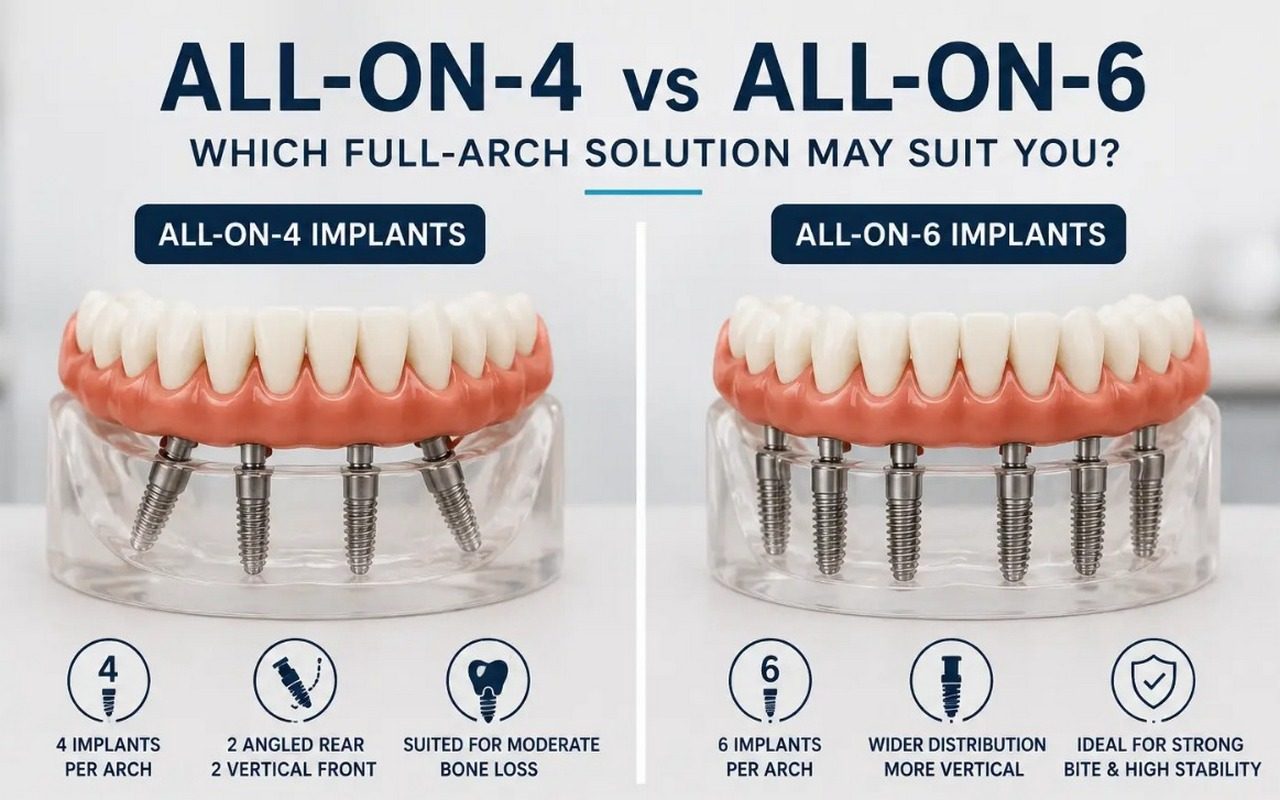
The phrase “All-on-4” was coined by Portuguese implantologist Paulo Malo in the late 1990s. The concept was to support a full arch of prosthetic teeth on the fewest implants that could reliably distribute bite load across the jaw. Four implants, two positioned vertically near the front of the jaw and two angled toward the rear at up to 45 degrees, gave surgeons a path forward even in patients who had lost significant bone volume in the back of the jaw, where resorption after tooth loss tends to be most severe. All-on-6 follows the same underlying principle but adds two more implants, typically placed in a straight orientation rather than angled. The extra fixtures spread bite force across more anchor points, reduce the mechanical load on each individual implant, and give the prosthesis more support where chewing pressure peaks. According to research published in the Journal of the American Dental Association, implant-supported full-arch prostheses show some of the highest long-term survival rates in implant dentistry when patient selection and bone quality meet clinical thresholds.
How the Four-Implant Configuration Works
The angled implants in an All-on-4 setup are not a compromise, they are a design feature. Tilting the posterior implants allows them to engage a longer section of bone without requiring bone grafting, which adds cost, healing time, and surgical complexity. For patients with moderate to advanced bone loss in the upper or lower jaw, this matters considerably. A grafting procedure can add months to the treatment timeline and several thousand euros to the overall cost. All-on-4 avoids this in most cases by working with the existing bone architecture rather than augmenting it first. The bridge loaded onto the four implants is typically a full arch of 12 teeth, fabricated from acrylic initially and often replaced later with a more durable material like zirconia once osseointegration is confirmed. Immediate loading, where the patient leaves with a functional temporary bridge on the same day as surgery, is more commonly offered with All-on-4 than with other implant configurations. For international patients who cannot make multiple trips back to the clinic, this is a significant practical advantage worth factoring into the comparison.
What Six Implants Add to the Equation
Adding two more implants to the arch changes the stress distribution in ways that are meaningful over the long term. With four implants, each fixture carries a significant proportion of the bite load, particularly the posterior ones. With six, the force disperses across more anchor points, which is beneficial in patients who have heavier bites, clench or grind at night, or whose bone density sits on the lower end of adequate. Six implants also provide redundancy. If osseointegration around one implant is compromised, five remaining fixtures can maintain the bridge while the issue is addressed, whereas with four, a failed implant represents 25% of the total support structure. The bone volume required for All-on-6 is generally higher. Patients need sufficient quantity and density along the full length of the arch, not just in the anterior and mid-sections. The National Institute of Dental and Craniofacial Research notes that ongoing bone health and appropriate follow-up care are central to long-term implant success, which aligns with why implantologists generally prefer more anchor points when a patient’s bone volume allows for it.
Which Patients Tend to Do Better With Each Option

Clinical selection criteria, not patient preference, should drive this decision. That said, certain profiles align more clearly with one system. All-on-4 is typically appropriate for patients with moderate to severe bone loss in the posterior jaw, those who cannot or do not want to undergo bone grafting, patients working within a tighter budget, and those who need treatment completed during a single trip abroad. The angled implant placement specifically solves the rear bone problem without additional surgery. Six implants make more sense when bone volume throughout the arch is good, when the patient has a strong bite or a parafunction habit like grinding, or when the implantologist judges that the long-term mechanical risk of four implants is too high for that individual’s anatomy. Patients over 60 with compromised bone density from systemic conditions, or those with higher-than-average bite force, are often counseled toward six where the anatomy permits it. A CT scan and a thorough clinical assessment by an experienced implantologist produce the actual answer, not a general preference for one number over another.
Cost, Value, and What Actually Goes Into the Price

The price difference between All-on-4 and All-on-6 is real but often smaller than patients expect. Adding two implants means two more surgical placements, more implant components, and sometimes a marginally more complex surgical plan, but the bridge framework remains the same. In Croatia and other popular dental tourism destinations, All-on-4 typically runs between 7,000 and 12,000 euros per arch, depending on the final prosthesis material and whether pre-surgical procedures are needed. All-on-6 generally adds 1,500 to 3,000 euros to that figure per arch. The wider gap appears when comparing those prices to Western European or North American equivalents, where the same procedures can run two to four times higher. Any quoted price should include the implant placement, abutments, temporary bridge, final prosthesis, and follow-up appointments. Implant brand also affects long-term performance more than patients tend to realize. A clinic offering a lower price by using unbranded or less-established fixtures is offering a different product from one using proven systems, even if the implant count is identical.